Oldest private
military preparatory school in the United States.
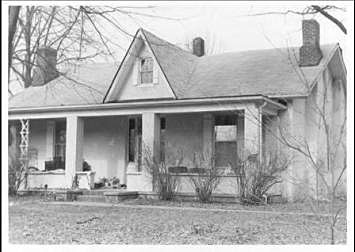
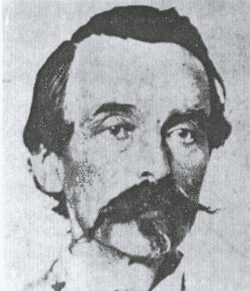
Founded in 1845 by General Robert T.P. Allen Chartered in 1847 by the State of Kentucky. 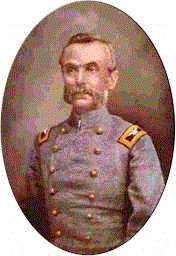 "Colonel Robert
Thomas Pircairn Allen"
|
|
Oldest private
military preparatory school in the United States.
Founded in 1845 by General Robert T.P. Allen Chartered in 1847 by the State of Kentucky. "Colonel Robert
Thomas Pircairn Allen"
|
|
The
Kentucky
Military Institute was established by Colonel Robert Thomas Pircairn
Allen,
a graduate of West Point, who was experienced in military and
education.
After graduation in 1834, Allen served as a captain in the Seminole War
and supervised military activities on Lake Michigan. He married
Julia
Bond, niece of President Andrew Jackson, whom he had met while visiting
the White House. After his retirement from the Army, Allen served
as a mathematics instructor at Transylvania University in Lexington,
Kentucky.
Allen and Julia visited the Scanlan Spring, or Franklin Springs, as it
was sometimes called. He was impressed with the beauty and
country
atmosphere and thought this would be a good location for a private
military
school. The property was located on Farmdale Road about six miles south
of Frankfort. By carriage it took about an hour to arrive at the
springs. In 1845, Allen purchased the property and opened his
school
as Kentucky Institute. Two years later a charter was granted by the
General
Assembly to Kentucky Military Institute. The school had a
reputation
for its excellent instructors, a demanding course of study and strict
discipline. It attracted many students from the South and a few
from
the North. After the Civil War, the school changed its curriculum
to prepare students for professional occupations. Robert Allen
turned
control of the school over to his son, Robert D. Allen. The
school
fell into bankruptcy in 1887 and closed its' doors, however, reopened
the
next year. Later KMI left its campus in Frankfort and moved to Mt.
Sterling,
Kentucky.
In 1896, under the
supervision
of Charles
Wesley Fowler, Kentucky Military Institute was again moved from Mt.
Sterling
to a campus in Jefferson County, Kentucky near Lyndon. Fowler, in 1906,
began the practice of moving students and faculty to a winter campus in
Florida during the months between Christmas and Easter. In 1924, the
school
again closed and reopened the following year under superintendent
Charles
B. Richmond. According to the city archives, KMI moved to Venice,
Florida
in 1932. The school prospered greatly under his direction. However, by
the late 1960's dissatisfaction with the military and rising tuition
cost
caused financial difficulties for KMI and other military schools. KMI
was
closed for the last time in 1973.
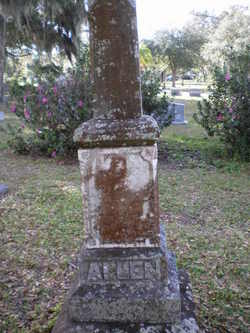
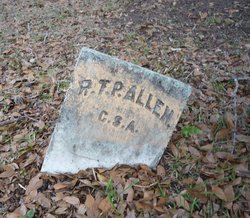
Sources: R.T.P. Allen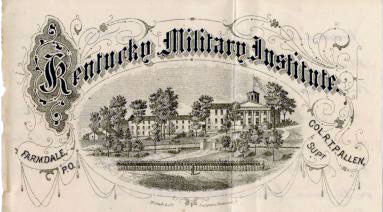 Kentucky Military Institute stationary header from letter written by Col. Allen Of Irish descent, Robert T. P. Allen was born in Maryland in 1813. Robert graduated near the top of his class from the U. S. Military Academy at West Point in 1834. That same year he married his wife Julia. Receiving short notice of the need to deploy with the 1st Artillery, U.S. Army, Robert was sent to Florida to fight in what would be the Second Seminole War. In 1836, 2cd Lt. R.T.P. Allen resigned his Army commission to be with his family. Robert was a multi-faceted man, working in various positions as an engineer and a college professor, while also becoming a minister. In 1844 he purchased land in Kentucky and opened the Kentucky Military Institute, chartered by the state as a military school. Leaving Kentucky behind a few years later, Robert held civilian and government jobs until approximately 1857, when he moved his family to Texas, where he established the Bastrop Military Institute. In 1861, Robert Allen dispatched a letter to Confederate President Jefferson Davis, offering his services to the Confederacy. Soon Colonel Allen was training men for Confederate service near Austin. Colonel Allen’s first fighting command with the 4th TX Infantry, later known as Hood’s Texas Brigade, was cut short, as the men under his command chafed under his strict leadership. Robert’s next assignment was recruiting and commanding the 17th Texas Infantry until June 1863 when he was wounded at the Battle of Milliken’s Bend in Louisiana. Following his injury, Col. Allen was appointed Commander of Camp Ford, a POW camp near Tyler, Texas. While Col. Allen was known for being a strict disciplinarian, he, and his wife, were known for their kindness. In a letter written by Union prisoners at Camp Ford, he was commended for “the kindness and gentlemanly courtesy with which he uniformly treated us”. Another POW, who recommended Col. Allen be given a pardon after the war, noted that “he with his family was untiring in his efforts to better our condition”. Mrs. Allen’s care and ministrations for the prisoners was well received, so much so that the hand-written newspaper published by the Camp Ford POWs, “The Old Flag”, featured a poem dedicated to her. New York-based Harper’s Weekly magazine printed an article on Camp Ford, mentioning the kindnesses afforded the prisoners by Col. and Mrs. Allen. In 1864, Col. Allen resigned from the Confederate Army and returned to his home in Bastrop, TX. Following the end of the war, military schools were forbidden and the military school at Bastrop was reopened as “Bastrop Collegiate Institute”, with the same teachers but minus the military education component. In 1866, the Allen family moved back to Kentucky where Robert resumed his leadership of the Kentucky Military Institute until his retirement, leaving his son to carry on at the school. Robert and his wife moved to Orange County, Florida after his retirement. Robert listed his occupation in 1880 as a “fruit grower”. In 1887, Reverend Allen had his book “Immortality of the Soul Voiced by Nature, and Christianity in Accord with Science” published by the Southern Methodist Publishing House. Robert died the following year and was buried in the Greenwood Cemetery in Orlando, Florida. Reprint of an original article on the Bastrop Military Institute website. ALLEN, ROBERT DICKINSON (1836–1913).
Robert Dickinson Allen, professor and Confederate officer, was born on January 19, 1836, in Washington, D.C. He was the son of Gen. Robert Thomas Pritchett Allen (1813–1888) and Julia Ann Dickenson. Gen. R.T.P. Allen was a distinguished graduate of West Point, became president of the Kentucky Military Institute, and established the Bastrop Military Institute (see TEXAS MILITARY INSTITUTE, AUSTIN). He also recruited the Seventeenth Texas Infantry Regiment of John G. Walker's Texas Division in Bastrop County in January of 1862. General R.T.P. Allen later moved to Florida, where he drowned in the Kissimmee River on July 8, 1888. Robert Dickinson Allen's early life revolved around his father's career. He was born in Washington D.C. and then lived in both Kentucky and Texas. He attended his father’s Kentucky Military Institute and studied medicine at the University of Louisville. By 1860 he was living in Bastrop, Texas, and worked as a math professor at Bastrop Military Institute. His first wife was Laura Adelaide Sims (1842–1885) of Clarksville, Texas. They married in Bastrop on June 14, 1858. They had four children. After the outbreak of the Civil War, Robert Dickinson Allen became captain of Company A of the Seventeenth Texas Infantry. He enlisted for duty as a captain at Camp Terry on March 7, 1862 and was promoted to major on April 2, 1862. He served as major for a little over a year before tendering his resignation on July 15, 1863, and officially resigned from duty due to ill health on August 26, 1863. After his son's resignation, General R.T.P. Allen moved his family from Texas back to Kentucky where he worked as a teacher and eventually became superintendent of the Kentucky Military Institute. After R. D. Allen's wife Laura died in Kentucky in 1885, he married Minnie Green of Louisville, Kentucky. His eldest son, Robert Sims Allen, would later become commandant of cadets at the Kentucky Military Institute. Allen eventually moved to Harris County, Houston, Texas, where he died on May 6, 1913. BIBLIOGRAPHY: Richard G. Lowe, Walker's Texas Division, C.S.A.: Greyhounds of the Trans-Mississippi (Baton Rouge: Louisiana State University Press, 2004). Sifakis Stewart, Compendium of the Confederate Armies: Texas (New York: Facts on File, 1995). |
||||||
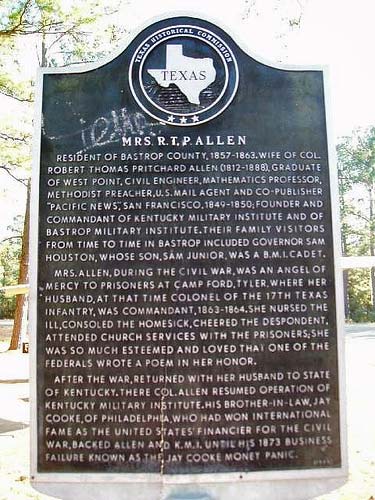 "Resident of Bastrop County,
1857-1863. Wife of Col. Robert Thomas
Pritchard Allen (1812-1888), graduate of West Point, Civil engineer,
mathematics professor, Methodist preacher, U. S. mail agent and
co-publisher "Pacific News," San Francisco, 1849-1850; founder and
commandant of Kentucky Military Institute and of Bastrop Military
Institute." "Their family visitors from time to time in Bastrop
included
Governor Sam Houston, whose son, Sam Junior, was a B.M.I. cadet."
"Mrs.
Allen, during the Civil War, was an angel of mercy to prisoners at
Camp Ford, Tyler, where her husband, at that time colonel of the
17th Texas Infantry, was commandant, 1863-1864." "She nursed the
ill, consoled
the homesick, cheered the despondent, attended church services with the
prisoners; she was so much esteemed and loved that one of the Federals
wrote a poem in her honor.""After the war, returned with her husband to state of Kentucky." "There Col. Allen resumed operation of Kentucky Military Institute." "His brother-in-law, Jay Cooke, of Philadelphia, who had won international fame as the United States' financier for the Civil War, backed Allen and K. M. I. until his 1873 business failure known as the Jay Cooke Money Panic ." |
||||||
|
Birth: Sep. 26, 1813 Death: Jul. 9, 1888 GEN. R.T.P. ALLEN was born in Baltimore County, Md., September 26, 1813, and is a son of Richard and Sarah (Hughes) Allen, both of Ireland. Gen. Allen graduated at the military academy at West Point in 1834; went into the Third Artillery, but served with the topographical engineers one year, until the Florida war; served as lieutenant of artillery in Gen. Scott's campaign against the Seminoles, when he resigned to go as a civil engineer in the government service, building harbors on Lake Erie, where he was engaged until the fall of 1838. He then resigned and became professor of the chair of mathematics and civil engineering in Alleghany College, at Meadville, Penn., where he remained until 1841, when he was appointed to the same chair of Transylvania University, Lexington, Ky., which he remained until 1845. In the fall of that year he established the Kentucky Military Institute, continuing until 1849 as superintendent, when he was appointed by President Taylor to take charge of the post office department of California and Oregon, which duty he performed until 1851. He then resigned and came back to Kentucky, to Franklin County, and resumed the position of superintendent of the Kentucky Military Institute, which he retained until 1854; then resigned and went to Cleveland, Ohio, and engaged until 1857 in general business, but principally in the coal business. In 1857 he went to Texas and established the Bastrop Military Institute; continued as superintendent of the school until the late war, when he closed the school and raised a regiment for the Confederate Army and went into the field in 1862. He remained two years and was then appointed to take charge of the prison camp near Tyler, Tex., where he remained one year; then resigned and took charge of the school in Texas again and remained until 1866; resigned and came to Franklin County, Ky., and resumed charge of the Kentucky Military Institute and continued as superintendent until 1874. Then his son, Col. Robert D. Allen, became superintendent, and the General became professor of the chair of mathematics, and continued until 1877, when he resigned and moved to Florida. There he engaged in orange culture until 1884, but in the meantime, from 1877 to 1884, was engaged in steamboat transportation between Lakes Tohopokaliga and Ocheechobee, Florida. In 1884 he returned to the Kentucky Military Institute and became professor of natural science. His son, Col. Robert D. Allen, was the superintendent, and John T. Gray the business manager. Gen. Allen was married July 8, 1834, to Julia A. Dickinson, of Nashville, Tenn., daughter of Jacob T. and Patsy (Bond) Dickinson, and great-granddaughter of Fell, who once owned the eastern part of Baltimore, Md. Two children blessed this union: Robert D. Allen, whose first wife was Miss Laura Sims, of Texas, by whom he had four children, of whom one only survives. Miss Minnie Green, of Louisville, Ky., is his second wife. Maj. Robert Sims Allen, the only surviving child, is now commandant of cadets at the Kentucky Military Institute. John Howard Allen is the general's second son, and is now practicing law in Orlando, Fla. He married Miss Sallie Bell, of Texas, and has five children: Howard J., Jay Cooke, Walter, Mary B. and Percy. Mrs. Sallie B. Allen died in 1886. Gen. Allen and wife are members of the Methodist Episcopal Church South, and he has been an elder for a number of years. He is also a Knight Templar. The secret of Gen. Allen's success in both public and private life rests in his stanch adherence to principle, his energy, his accuracy and a thorough performance of every duty. He is modest with regard to himself, unselfish and thoroughly amiable in disposition. -- Kentucky: A History of the State, Battle, Perrin, & Kniffin, 5th ed., 1887 |
||||||
|
||||||
 |
Kentucky
Military Institute www.kmialumni.org Send e-mail to: kmimail@kmialumni.org Copyright © All rights reserved. |
 |