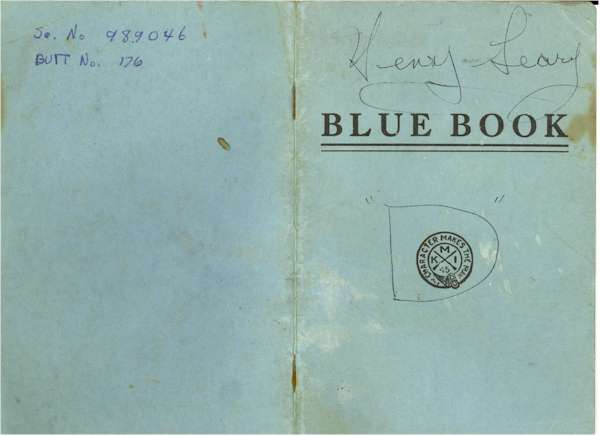
BLUE BOOK OF RULES AND REGULATIONS

1960 Edition provided by Hank Geary, KMI '62
1. The Kentucky
Military Institute is essentially a military school, and the school
authorities promise parents (or guardians) of cadets strict supervision
over their sons (or wards) entrusted to their care. Such supervision
will be complete insofar as possible. Cadets, who by temperament or
otherwise are not suited to such control, should request consent of
their parents to withdraw.
2. Cadets will
remain on the school campus except at such designated periods when they
will be allowed to go on leave, as provided in these regulations.
3. Four
principles underlie all cadet duties, viz..: honesty, cleanliness,
punctuality, and thoroughness. Cadets will apply these
principles constantly.
(
a ) Honesty: The 'cadet in his life at K. M. I. will
measure his actions by a standard of honor which will make him true to
himself, to his duty and to his fellow cadets in the broadest and best
sense; he must realize that it is not fair to any cadet to allow him to
fail in his duty and by so doing build up habits of carelessness and
disrespect for law. Similarly, with regard to himself, he must feel
that evading punishment or securing anything to which he is not clearly
entitled cannot compensate for a lowered standard of honor.
(
b ) Cleanliness: The cadet will be clean in the most
exacting sense of the word. His hair must be short, face clean shaven,
and his body and clothing meticulously clean at all times. His
equipment, furniture, room and every article and place for which he is
responsible will be kept clean and tidy. Articles which can be shined
will be so kept.
(c)
Punctuality: Each cadet will be punctual at every
duty and appointment, whether he is summoned by a general
call or obliged to watch the time for himself, or otherwise.
(d)
Thoroughness: In
performance of duty, military or academic, cadets will fully inform
themselves as to their duty and be thorough and painstaking, carrying
such duty to completion at the time prescribed.
ABSENCES
4.
Only the President, the Commandant of Cadets, the School Surgeon, or
the officer in charge, may excuse a cadet from any duty.
5.
Cadets will be reported absent from any formation when not in ranks
before the cadet calling the roll makes his report. This report will be
made immediately upon completion of roll call.
6. Cadets will be reported absent from any duty or skipping duty when
they do not join before its completion. Cadets will be reported late at
a formation when not in their exact and proper places at the last note
of assembly, but join before they are due to be reported absent.
7. Unless expressly so stated, no privileges granted to cadets will
excuse them from any duty confinement or punishment.
8. Cadets directed to report at any office, or to any instructor, or at
the guard room, will do so at the first opportunity when no duty will
be interfered with; if a cadet is in conference with any officer and
has any duty or formation, he will inform the officer of that fact in
time to be present at the duty or formation.
ACADEMIC
INSTRUCTION
9.
Cadets will be called to attention by the Senior cadet present for roll
call at the last note of assembly, and, also, when the instructor
enters the class room after assembly has sounded. When recall is
sounded, the Section Leader will rise and take a position near the
classroom door. When the instructor dismisses the section, he will
command (1) "Rise," (2) "March Out."
10. Cadets will bring to the recitation room lead pencils and such
books and equipment as directed.
11. Cadets will be permitted to leave the classroom only when
authorized by the instructor. Such cadets will be reported by the
instructor for leaving classroom by permission for minutes.
12. A cadet will be excused from academic recitation only by the
Surgeon on account of sickness or physical disability, by the President
or Commandant on account of emergencies interfering with his regular
study hour, or for certain necessary guard duty.
13. The three ranking cadets of each section will carry a copy of the
roll with them so that they can act as section leader without advance
notice.
14. Cadets will not lounge in seats of classrooms. Respectful conduct
and proper military courtesy will be accorded members of the academic
faculty at all times.
15. All cadets will be punctilious in the use of the word "Sir" when
addressing an instructor.
16. Cadets will always present a neat appearance in the classroom. Ties
will be kept fastened and sleeves rolled down.
17. Cadets will be considered late to class if not in their designated
seats at the last note of assembly.
18. The section leader, after calling the roll, will report absentees
to the instructor and prepare a written list of absentees and lates for
the officer of the day.
19.
In case an instructor is absent from the classroom on arrival of the
class, and does not arrive within ten minutes, the section leader will
report to the Headmaster for instructions.
AUTOMOBILES
20. Under no circumstances will any cadet have in his possession any
automobile, motorcycle, or other motor vehicle. Unless accompanied by
parents or guardians, cadets will not drive any motor vehicle.
BULLETIN BOARD
21. Cadets are required to inform themselves daily in regard to all
matters published on the official bulletin boards.
BARBER
22. Cadets will wear their hair short and be cleanshaven at all times.
23. Cadets may visit the school barber at any time provided that it
does not interfere with any duty, and they sign off at the guard room.
Cadets having vacant recitation periods may visit the barber at the
rate of 3 cadets to each barber-one cadet being in the barber chair and
the others waiting. During recitation periods a member of the guard
will make frequent inspections of the barber shop to see that the
provisions of this paragraph are being complied with.
CADET OFFICERS
24. All cadet officers are responsible for the enforcement of
regulations and orders, the maintenance of discipline, and the
instruction of cadets placed under them. Cadet officers are not
authorized to grant permissions during Call to Quarters or during
vacant class periods.
25. The responsibility of the cadet officer is not lessened because a
cadet senior to him is present or because another cadet on duty is
present, such as a member of the guard or stoop inspector. It is the
duty of every cadet officer, of whatever grade, to support the
authority of others and to assert his own authority whenever a breach
of discipline makes it necessary at any time, in any place, and under
all circumstances. If he expects to be a leader, he must not be afraid
to require obedience from any cadet under him and to report any such
cadet for a breach of regulations.
26. The senior cadet officer quartered in each barracks is responsible
for the interior discipline and police of the barracks. He will be
assisted by the stoop inspectors (commissioned officers) and
non-commissioned officers who are assigned supervision over
subdivisions of the stoops.
Stoop Inspectors
27.
The stoop inspector is responsible for the police and general good
order of his stoop, including the porch in front of rooms. He will stop
any noise, scuffling, disorderly or improper conduct, which occur in
any part of his stoop; if the irregularity is important enough, he will
make an immediate report of it to the Officer in Charge.
28. At police inspection he will accompany the inspecting officer and
record the reports and turn same in to the Officer of the Day
immediately after completion of inspection.
29. He will report any cadet who sweeps or throws trash in front of
another cadet's room.
30. Immediately after assembly for evening call to quarters, and
immediately after taps, he will go to each room on his stoop and make
sure, either by report "right,"or by personal inspection that all are
present. After taps he will make sure that all are present and the
lights out unless there is authority for the occupants to be out of
bed. After each of these inspections he will prepare a written list of
absentees and lates, which will be turned in to guard room.
Assistant Stoop Inspectors
31.
The non-commissioned officers assigned subdivisions of stoop will
assist the stoop inspector in maintaining order.
CALLS
32.
The current list of calls for all formations and classes will be
published in orders and kept posted in the guard room.
33. An interval of at least five minutes will be permitted between the
sounding of "first call" and "assembly" at routine formations.
34. Blowing the bugle in the vicinity of barracks is prohibited except
by the bugler of the guard for official calls.
CALL
TO QUARTERS
35. At the signal of call to quarters cadets shall at once go to their
rooms unless required for duty elsewhere. The 5:30 p. m. call to
quarters in Kentucky on week days is simply a warning to indicate 30
minutes before the evening meal. The 5:30 p. m. on Sundays is the
regular call to quarters and all cadets will go to their rooms before
assembly sounds. The 5:30 call to quarters on Sunday also indicates the
end of the visiting hour. Cadets will be considered late call to
quarters if they are not inside their rooms with doors closed at the
first note of assembly.
COURTESIES
36.
All cadets will salute all officers of the faculty, the officer of the
day on meeting, passing, and reporting.
37. Salute shall be rendered as prescribed in the training
regulations-in a smart and soldierly manner.
38. When reporting to an officer a cadet shall knock on door, enter
office, salute and report in the prescribed manner. (Example): When
ordered to come in, march to within two paces of the desk and halt,
salute, and report your presence as follows: "Sir, Cadet (Jones)
reports his presence." Upon leaving an office a cadet shall salute,
face in a military manner toward the door and leave promptly.
39. When an officer enters the room of a cadet, or when cadets are
congregated in a room, they shall rise and stand at attention.
CORRECTION OF INJUSTICE
40. Any cadet who feels himself wronged by an officer or another cadet
may state his case in writing to the President of the Kentucky Military
Institute.
41. All combinations or joint actions of cadets for the purpose of
violating or evading regulations, orders, or instructions, issued by
competent authority or for the purpose of expressing disapprobation or
censure of any person connected with the school, are prohibited.
CAMPUS BOUNDARIES-KENTUCKY
42. The following are the limits of the campus until 7p.m.
(a)
North-line running east with the fence behind Fowler Hall.
(b) East-the road behind Barracks No. 2.
(c) South-Lyndon-Anchorage Road.
(d) West-a line running north and south with the fence at the lower end
of the athletic field.
42-A. The following are the limits of the campus after 9 p. M.
(
a ) North-line running east and parallel with the rear of Fowler Hall.
( b ) East-the road behind Barracks No. 2.
( c ) South-line parallel with the inner front gate from the hedge
beyond the tennis courts, and extending to the end of the athletic
field.
( d ) West-a line running north and south with the fence at the lower
end of the athletic field.
BOUNDARIES-FLORIDA
43. The following are the limits of the campus:
( a ) North-School property in
rear of San Marco.
( b ) East-Tamiami Trail.
( c ) West-Beach.
( d ) South-Miami Avenue.
The
following places on the campus are off-bounds:
( a ) Kitchen.
( b ) Dining room, except during meals.
( c ) Fowler Hall, except for regular assigned occupants.
( d ) Guard House, except for members of the guard.
( e ) A cadet's room in the absence of occupants.
( f ) The attic in Ormsby Hall.
(g) Second and third floors of Venice Hotel, except regular assigned
occupants.
(h) Second and third floors annex, except regular assigned occupants.
( i ) First, second and third floors Gregg Hall, except regular
assigned occupants.
( j ) Hospital, except cadets confined to their beds by
doctor's orders.
(k) All school offices, except on official business.
DANCE REGULATIONS
44.Conduct at the dance must be that of a gentleman.
All cadets attending a dance at K.M.I. are required to report off at
the guard room. They will then proceed to Ormsby Hall, where they will
meet their dates.
No cadet is permitted to invite a young lady to a dance until he has
first turned in her name to school office, from which an invitation
will be sent. Each young lady attending the dance must present her
invitation at the door.
Cadets will be permitted to leave the dance hall from time to time
throughout the dance, but must confine themselves to the walk leading
from the east door of the gymnasium to Ormsby Hall and the Dug-Out.
During intermission cadets may "walk their dates" on the walk from the
east end of the gymnasium to the west entrance of the Dug-Out and, in
addition, may walk around the circle in front of Ormsby Hall. At no
time during the dance or intermission are cadets allowed to enter
automobiles for any purpose.
Any cadet who is found off limits, as specified above, is subject to
demerits; will not be allowed to attend another dance throughout the
school year; and will be confined to quarters immediately following
Vesper Services until dinner formation for four consecutive Sundays.
Any young lady who fails to keep within the prescribed limits, as
mentioned above, will not be permitted to attend K.M.I. dances for the
balance of the school year, nor will she be permitted to have dates on
the campus following the Vesper Services on Sunday afternoons.
Immediately after allowing the young ladies to remove their coats upon
entering the dance hall, all cadets should introduce their ladies to
all of the chaperones or hostesses. When a receiving line is formed all
cadets and their dates should greet everyone in the line. Upon reaching
the head of the line the cadet should introduce his lady to the first
person in the line, saying, "Colonel Richmond, may I introduce Miss ,"
and then give his own name, "Cadet ." This is a courtesy governed by
social custom. If your parents are here and you are attending the dance
ask them to join you and see that they meet those in the receiving line.
DELINQUENCY REPORT
45. A delinquency report is a report entered against a cadet for
failure (or neglect) of duty, or for violation of the regulations. Such
reports shall, as far as practicable, be confined to a simple and plain
recital of facts. Time and place are important factors.
46. Delinquency reports will be entered on proper form by cadets only
in their official capacity. Spite reports are prohibited and cadets
entering such reports will be punished for "assumption of authority."
47. A cadet reported for violation of regulations shall not hold
conversation with the reporting officer unless permission has been
obtained from the cadet's tactical officer or the Commandant.
48. A cadet once having entered a report may not withdraw it without
permission from the Officer in Charge.
DEMERITS
49.
Demerits are a means of rating cadets in conduct. They will be awarded
for every report which is not marked satisfactory or removed.
EXPLANATION OF REPORTS
50. Reports will be answered by companies to the tactical officers. The
ranking cadet, on each company delinquency report, will obtain the
company report sheet from the office, and will be held responsible for
the group.
51. An explanation will consist of a straightforward, clear, and
complete recital of facts. It will not contain criticism, complaint,
argument, or any irrelevant remark, or quibbling or denial of a report
when a matter of opinion is involved.
52. If any explanation places responsibility on another cadet, he will
be named.
53. Cadets receiving explanations or other papers for endorsement shall
return the same properly endorsed to the Commandant's office the same
day they receive them.
54. In answering a report, if a cadet wishes to discuss the report with
the reporting officers and request its removal, the tactical officer
will issue the cadet a removal slip.
55. The removal slip will be filled out neatly, giving the date, name,
company, name of the reporting officer, the report, the number of the
report sheet it appeared on, and a concise written explanation of the
report. The removal slip shall be taken to the reporting officer who
shall use his discretion in recommending that the report be removed, or
not removed, and will sign the removal slip accordingly.
56. The removal slip shall be turned in to the tactical officer at the
call for explanation of reports the following day. Removal slips will
not be honored unless they are turned in promptly.
GENERAL RULES
57. Cadets absent from any formation on account of attendance at some
other duty, will, upon completion of the latter duty, join their proper
command regardless of the length of time remaining.
58. Duty Rosters will be kept in accordance with the rule "The longest
off-duty is the next due." Cadets will not exchange any duty assigned
by roster except on written application provided by the Commandant.
59. Cadets will always stand at attention when addressing or being
addressed by a faculty officer.
60. Cadets will not gamble in any way for stakes, however small. Card
playing is prohibited except in the lounge of Ormsby Hall, Senior Room,
and in the Lobby of the Venice.
61. Every cadet must scrupulously respect the property of others. The
borrowing or lending of equipment, uniforms, wearing apparel, or other
articles or property, public or private, is prohibited.
62. No cadet will visit another cadet's room in the absence of all
occupants, except in an official capacity. Cadet officers will report
such violators for "off-limits" in Room No. , when all occupants. are
absent.
63. All cadets reporting to the Officer of the Day will do so in person
and will go to the guard room to make the report. Cadets reporting
departure from the school grounds will sign off in the guard room
immediately before they depart and will report immediately after their
arrival on the school grounds before going to their rooms.
64. Trash baskets are placed in cadets' rooms. Cadets will use these
receptacles for depositing trash and will not throw or sweep trash or
dirt on the stoops or on the formation court.
65. The shooting of rifles or other firearms on or near the grounds is
prohibited.
66. Cadets shall not have in their possession or in their quarters
ammunition of any kind.
67. Hitch hiking or asking for rides is forbidden.
68. Cadets shall not engage in personal encounters without permission
of a faculty officer, who will witness the fight and insist on fair
play.
69. Cadets may be dismissed or less severely punished for calling to
personal account another cadet for having, while in the execution of
official duty, corrected or reported the offending cadet.
70. No cadet shall have in his possession firearms of any description,
except such as may be officially issued to him.
71. The use of profane, impure, or improper language is prohibited.
72. Any cadet who shall, when absent from the school, commit any act
reflecting on the good name of the Corps of cadets may be punished as
if the act had been committed on the campus.
73. Cadets will not run on the stoops of the barracks or in the halls
of the academic building.
74. Throwing on the formation court or vicinity of buildings at any
time is prohibited.
75. Screens in windows in cadet quarters, or in classrooms, will not be
unfastened, removed, or damaged in any way.
76. Ignorance of regulations and orders will not be accepted as an
excuse for misconduct.
GUARD
77. The guard will consist of one Officer in Charge, one Cadet Officer
of the Day, one Commander of the Guard, Sergeant of the Guard, and one
Private of the Guard, and such other cadets as the Commandant of Cadets
may deem _necessary and proper.
78. It should be understood by all, that cadets on guard duty are on
their honor to perform all the duties of their office faithfully.
Cadets on guard are expected to conduct themselves in a dignified
manner and present a soldierly appearance at all times.
OFFICER IN CHARGE
79. An Officer in Charge shall be detailed from the Corps of
Instructors. He shall have general supervision of the routine during
his tour of duty, shall direct the Cadet Officer of the Day in the
performance of his duties, shall make such inspections of quarters and
buildings as the President or Commandant may direct or as in his
judgment may seem necessary, shall take prompt measures to check all
irregularities, abuses, or violations of regulations or orders that may
come to his knowledge and shall consider himself responsible for the
proper carrying out of the daily routine.
80. Officer of the Day:
( a ) The Officer of the Day shall be vigilant in the discharge of his
duties and shall require the utmost respect from all cadets.
(
b ) The Officer of the Day will require all cadets rigidly to observe
military courtesy in addressing him. Cadets in addressing the Officer
of the Day or Commander of the Guard, shall use the forms "Mr. Officer
of the Day (or Commander of the Guard); Sir ," etc.. Familiar names or
terms shall not be used.
(
c ) The duties of the Officer of the Day shall never be delegated to
any other person without special authority of the Commandant.
(
d ) The Officer of the Day is responsible that all calls are sounded at
the proper times. He shall never delegate this responsibility to
another.
(
e ) The Officer of the Day shall be present at and receive the reports
of all roll calls. He shall check lates at all formations and report
Detachment Commanders when such lates are not reported.
(f)
Immediately after his last inspection the Officer of the Day shall
furnish the Officer in charge with a list of all authorized absentees.
Should no cadets be absent, he will report accordingly to the Officer
in Charge.
(g)
Should the Officer of the Day find that a cadet is absent without
leave, he shall immediately report the fact to the Commandant and to
the Officer in Charge, and thereafter shall inspect the room of the
absent cadet every fifteen minutes until the absent cadet's return.
(h)
The Officer of the Day is responsible that punishment is properly
served by cadets whose names are on the punishment list. He shall also
see that proper credit be given.
(i)
The Officer of the Day is on honor to perform his duty at all times and
under all circumstances. This should be fully understood by all cadets.
(
j ) The Officer of the Day is required to report all irregularities,
neglects, breaches of discipline, or other acts inconsistent with the
provisions of these regulations or with the soldiery or moral character
of cadets which may come to his notice.
(
k ) The Officer of the Day shall see that all absentees report to duty
at once unless excused by proper authority.
(1)
The Officer of the Day shall not permit cadets other than those on
guard to enter the guard room.
(m)
The Officer of the Day shall not visit in quarters with other cadets
unofficially during the tour of duty.
(n)
The Officer of the Day is responsible for proper enforcement of
regulations governing vacant class periods.
(o)
Cadets transacting business with the Officer of the Day or any member
of the guard shall do so in a business like and soldierly manner. They
shall stand at attention and salute at the beginning and at the end of
the conversation.
81. The members of the Guard are required to remain in or in the
vicinity of the guard room at all times.
COMMANDER OF THE GUARD
82. The Commander of the Guard will assist the Officer of the Day in
the performance of his duties. The Commander of the Guard shall prepare
and keep in duplicate all delinquency reports in alphabetical order.
The Commander of the Guard will not visit unofficially in the rooms of
the other cadets during his tour of duty.
PRIVATE OF THE GUARD
83. The Private of the Guard will remain in the Guard Room except when
sent on duty elsewhere. He will show all visitors into the reception
rooms. The Private of the Guard is responsible for the police of the
Guard Room. Under no circumstances shall the Private of the Guard enter
reports, handle permits, report cadets on or off or have anything to do
with the duties of the Officer of the Day or the Commander of the
Guard. The Private of the. Guard will be relieved from duty at Taps.
HONOR SYSTEM
84. This famous instrument of cadet government has had a prominent part
in building character at the Kentucky Military Institute. Remember the
K.M.I. Motto, "Character makes the Man."
85. The Honor System obligates cadets to tell the truth in all official
statements to faculty officers, cadet officers, non-commissioned
officers, and other cadets while on duty. It forbids the dishonorable
furnishing, gaining or using of information in class or on an
examination.
86. The Honor System is binding on everyone, old and new; cadets are
bound to report any violation of it they observe or suspect; otherwise
they become violators.
87. It is not telling on another cadet; it is considered a sacred duty,
and keeps the Corps free of the thief, the liar, and the cheat.
88. A Student Council is elected to administrate the Honor System.
INTOXICATING LIQUORS
89. Cadets who shall drink or be found under the influence of alcoholic
beverages, or bring or cause same to be brought within cadets' limits
or otherwise in their possession, shall be expelled from the Kentucky
Military Institute or less severely punished.
LEAVES OF ABSENCE
90. Application for leave will show: extent of leave desired, setting
hour beginning and end, purpose of leave, detailed statement of duties
missed. In case no duties will be missed, a statement to that effect
will be made; a statement that no undue advantage will be taken of the
leave, if granted.
91. Any cadet who finds it impossible to return before the expiration
of his leave of absence should telegraph or write for an extension. Any
cadet who fails to do this and is late in reporting his return will be
subject to punishment unless he submits a surgeon's certificate showing
that he was unable to return at the appointed time.
92. Cadets taking advantages of a leave or absence will report their
departure and return to the guard room.
WEEK-END LEAVES
93. Week-end leaves will be granted only to cadets for the purpose of
spending the time with cadets' parents or close relatives of mature age.
94. Under no condition will cadets taking week-end leaves be permitted
to have other cadets accompany them.
85. Week-end Leave (Oct. 20-Christmas) - Cadets who live within a
reasonable distance from the school are authorized to make application
for one week-end, from after drill on Saturday until the following
Monday at 7:00 P. M.-provided:
( a ) Parents have submitted, in writing, request for the leave to the
office by Thursday before the desired week-end leave. Telephone calls
and telegrams are not acceptable.
(b) Cadet has satisfactory conduct record. 8 merits.
(c) Cadet has passed all academic work during the previous month.
(d) Cadet's room is thoroughly clean and ready for inspection.
(e) Cadet has dependable transportation, sufficient funds for trip, and
no duties or punishments to serve.
WEEK ENDS-FLORIDA TERM
96. Cadets are permitted one week-end leave during the winter term in
Florida, provided all requirements have been complied with.
97. Applications for week-end leaves must be on regular forms and reach
the Commandant's office by 7 p. m. ~ on Thursday.
98. No week-end leaves will be granted after spring vacation.
99. Cadets who do not take advantage of their week-end privilege of the
fall term will be permitted to leave one day early at Christmas
vacation. Cadets who do not take advantage of their week-end leave in
Florida will be permitted to return one day late at Spring Vacation.
LETTERS
100. Cadets are required to write a letter to their parents (or
guardians) each Sunday night. These letters will be collected by the
stoop inspectors and turned in to the Officer of the Day.
LIBRARY
101. The library will be open from 8 a. m. until 2:30 p. m. and from
7:30 p. m. until 8 p. m. Cadets who wish to visit the library during
their vacant study period or vacant military period will secure a
library permit from the guard house or from any classroom and will have
the permit signed by the instructor for whom he is going to prepare the
assignment in the library. Cadets in the vacant period supervised study
hall will report off to and have his permit signed by the instructor in
charge of the study hall. The permit will be presented to the librarian
upon arrival at the library and will be signed by her upon leaving. The
cadet will then return the library permit to the instructor in charge
of the study hall. Cadets who study in their rooms during vacant
periods will follow the same procedure as described above except that
they will report off at the guard house and report on there upon
leaving the library.
102. No book or magazine shall be taken from the library except when
issued by the librarian.
103. Notice to cadets that books are overdue or are to be returned have
the force of orders. Books will be returned to the library within the
time limit.
LIGHTS
104. Lights will not be kept burning while the occupants of room are
absent. On nights of study lights will in general be put out at taps.
105. For the purpose of retiring, cadets returning from leave after
taps shall be allowed a light for ten minutes after reporting on bounds.
106. Interfering or tampering with any part of lighting system is
prohibited.
107. Electric appliances or fixtures of any kind, not supplied by the
school, are prohibited, unless special permission to have them be
obtained from the President.
LOST ARTICLES
108. Any cadet, who has lost an article, will notify the Adjutant,
furnishing identifying marks . The Adjutant will publish notice for
lost articles on the bulletin board.
109. The inspections for lost articles will be made by members of the
Student Council.
110. Lost articles, when found, will be turned in to the Officer of the
Day at the guard room. A list of lost articles turned in with
identifying marks will be published by the Adjutant with instructions
for the owners to call for them. Officers of the Day, on going off
duty, will turn in to the business office all lost articles which have
not been called for.
MARKING UNIFORM AND EQUIPMENT
111. All articles of clothing or property may be marked with the issued
stamp, regardless of the fact that they have been previously marked
with name tapes or other types of marking devices.
The following articles may be marked at the exact place indicated below:
BOOKS - Inside of front cover page at top, and on page 52.
CAP - Inside of hat band, and underneath visor.
BLOUSE - On tag inside pocket and on lining of right sleeve one inch
from end.
SERVICE TROUSERS - Woolen Inside right waistband justabove watch
pocket.
SERVICE TROUSERS - Cotton Inside right waistband just above watch
pocket.
DRESS TROUSERS - Inside right waistband on back of watch pocket.
WHITE DUCKS - Inside right waistband on back of watch pocket.
K.M.I. BELT - Inside in middle of belt.
WIND BREAKER AND WOOL JACKET - On tag in neck band. If tag has been
removed another will be sewed on.
SHIRTS, white and grey ... Middle of collar band and on right shirt
tail (front).SHOES Inside near top on right sideof both shoes.
BEDROOM SLIPPERS - Inside near top on right side on both slippers.
CROSS BELTS - On one end of each piece of belting.
WHITE GLOVES -Inside at point where glove covers top of wrist.
OVERCOAT -On lining one inch below collar chain.
COVERALLS -One inch below collar.
112. The articles listed below will be marked with approved stamp at
most convenient place:
Athletic
Shirt, Laundry Bag, Sweat Shirt, Athletic Trousers, Raincoat,
Tennis Racket, Bathrobe, Sewing Kit, Tennis Shoes
MEETINGS
113. Meetings of the corps, or class meetings, may be held at any time
during release from quarters, with permission from the officer in
charge, provided they do not extend recitation periods or call to
quarters.
114. The senior cadet officer present in corps meetings, or the senior
class officer, in class meetings, is responsible that no disorders
occur, and that lights are extinguished upon the termination of the
meeting.
MESS HALL
115. When entering the mess hall each cadet will move directly to his
own place and stand at attention behind his chair until the command
"Seats" is given. Faculty officers, cadet officers, and
non-commissioned officers are assigned as heads of tables and are
charged with the maintenance of good order and with the supervision of
table manners. The conduct of gentlemen is always expected in the mess
hall.
PUBLIC PROPERTY
116. Cadets will not mark public property. They will not alter or
deface public property or use it for any unauthorized purpose.
117. Rifles left on the formation court or at other unauthorized
places, will be considered as an act of gross carelessness and will be
punished accordingly.
118. Cadets will be charged for all damage to public property which is
not the result of fair wear and tear in service.
PUNISHMENT
119. The punishments to which a cadet shall be liable, in addition to
the number of demerits awarded for the offense, are as follows:
Confinement to restricted limits, penalty tours, reprimand, reduction
of officers, and noncommissioned officers, dismissal, and expulsion.
120. Punishment may be inflicted by the Commandant of cadets, and by a
Board of Discipline, consisting of the President, the Commandant, the
Assistant Commandant, and the P. M. S. & T.
121. Penalty tours will be served every afternoon after drill and on
Mondays. Each tour will be fifty minutes' marching, with ten minutes'
rest between consecutive tours.
122. A cadet in confinement is restricted to his room which he may
leave only for the following purposes by reporting departure and return
to the officer of the day:
( a ) To visit the hospital by authority or in emergency, no credit
being given while absent.
(
b ) To visit toilet for proper purpose.
123. Inspection for confinements will be made by the Officer of the Day
once during each confinement.
124. "On Bounds" or "Yard Limits" (Kentucky) are defined as the area of
barracks, tennis courts, and athletic field. They are that part of the
campus between the yard gate and the north line of barracks. The main
building, the gymnasium, and the academic building are included in yard
limits.
125. "On Bounds" or "Yard Limits" (Florida) include the barracks, the
tennis courts, the basketball court, and the area between the barracks
and the Venice Hotel. Cadets in restricted limits are not permitted to
cross Venice Avenue or enter any of the stores and shops in Venice.126.
Cadets restricted to "Yard Limits," or "On Bounds" will report to the
officer of the day at the guard room as follows:
Week days between 4:45 and 5:15 p. m.
Mondays between 10:00 and 10:30 a. m.
Mondays between 2:00 and 2:30 p. m.
Mondays between 4:00 and 4:30 p. m.
Mondays between 5:30 and 5:45 p. m.
127.
The above requirements will not interfere with any official duty.
128.
Cadets are permitted to have radios and television in quarters. They
may be played under the following regulations:
(
a ) They shall not be played during any class periods or study periods.
(
b ) They shall not be played during general inspection.
(
c ) They may be played during letter-writing period.
(
d ) They may be played during any recreation period.
(
e ) A cadet found playing his radio or television in violation of these
regulations shall on the first violation, in addition to demerits, be
required to store his radio or television for a period of two weeks; on
the second violation a cadet's radio or television will be stored for a
period of six weeks.
RECREATION
129.
Cadets will not be permitted to remain in barracks during afternoon
except cadets in confinement. Weather permitting, the barracks will be
vacated thirty minutes after recall from drill.
REPORTING OF ABSENTEES
130.
(
a ) Normally, the squad leader reports absentees of his squad to
Platoon Sergeant.
(
b ) The Platoon Sergeant reports these absentees and any absent guides
to the 1st Sergeant.
(c)
The 1st Sergeant reports these absentees to the Company Commander.
(d)
The Company Commander reports the absence of any Lieutenants and the
absentees reported by the 1st Sergeant to the Officer of the Day.
(
e ) The Battalion Commander reports the absence of the Adjutant and any
members of the Staff to the Officer of the Day.
(f)
The Officer of the Day reports the absence of the Battalion Commander.
(
g ) In case all the commissioned officers of a company are absent, the
senior N. C. O. in charge of the company reports the absence of all
commissioned officers and the absence of any non-commissioned officers
senior to him who may be absent, in addition to making the report of
absentees given to him by the Acting 1st Sergeant.
(
h ) In any case, where a cadet is acting in a capacity higher than his
normal rank, he will see that all absentees junior in rank and ranking
up to the position for which he is substituting will be reported.
For Example - If Corporal Jones finds himself the senior cadet in a
company he commands the company and reports all absentees in the
company up to and including the company commander, as follows:
"Cadet
Pvts. A. and B, Cadet Cpl. C, Cadet Sgts. D, E, F, G, Cadet Platoon
Sgts, H. and I, Cadet 1st Sgt. L, Cadets Lts. M and N, Cadet Captain 0,
absent, Sir."
RIGHT
131. The report "Right" from any regularly assigned occupant of a room
at taps means that all occupants are present in the room, that no other
persons are in the room, and that all occupants are undressed and
properly in bed.
132. Loud yelling in making these reports is for• bidden.
ROOMS
133. Rooms in barracks will be arranged as prescribed by the
Commandant.
134. Rooms will be thoroughly swept, beds, made; furniture, shelves and
woodwork dusted, before police inspection each day. They will be kept
ready for inspection at all times.
135. Floors, walls, woodwork - Keep the floor, walls and woodwork clean
and free from stains, spots, dirt, scratches, and nails.
136. No trash shall be swept on the stoop, but will be taken up inside
of rooms and placed in waste basket. Waste baskets will be placed on
stoop in front of room door before assembly for inspection.
137. Rooms will be properly ventilated at all times. After taps,
windows will be opened.
138. Room Orderlies-The occupants of each room shall alternate weekly,
beginning Sunday morning, in the performance of Room Orderly. They
shall be detailed by the ranking cadet officer. Card of Orderly In will
be placed in right bracket on room door, as inspector faces door from
stoop, card of Orderly Out in left bracket.
139. When an Orderly is absent or prevented by sickness from attending
to his duty, the occupant present next for duty shall perform the duty
of Orderly as if regularly assigned.
140. Each cadet will arrange his own bed, furniture and personal
effects, will sweep the floor, dust and clean all woodwork and common
property (table, mirror, basin, etc..). The Orderly Out is responsible
for his own equipment and for the cleanliness of that portion of the
stoop in front of his room at all times.
141. All uniform parts will be hung on hangers in closet.
142. Civilian clothes will not be kept in barracks.
143. No more than five cadets will be permitted to assemble in any room
in the barracks without special permission extent 7 in 4-man rooms.
SENIOR
144. A senior is any cadet who has earned 111A units and is carrying a
graduating schedule. A senior who has failed in any subject
during the previous report period is not entitled to Senior Leave.
SICK
145. Cadets who wish to go on sick report shall report to the surgeon
at Sick Call.
146. Except in emergencies, cadets requiring medical attention at other
times shall secure written permission from the O. C. or Commandant
before reporting to the hospital.
147. Cadets who are on sick report, as excused drill or parade, will
remain in quarters during the drill period and during parade on Sunday,
unless other duties are assigned by the P. M. S. & T.
148. Cadets confined to their beds in the hospital will not be
discharged from the hospital until Sick Call the following day. Sick
permits are good for one day only unless marked "Special" by the
surgeon or unless the cadet be placed in the hospital. All permits
expire at Sick Call the following morning.
149. Cadets on sick permit and excused from any formations or duties
are not allowed to participate in athletics except by permit from the
Commandant.
150. Cadets excused ranks or formation by the surgeon will assemble in
the sick squad for all routine formations. The sick squad will form at
mess call company to enter the mess hall. A cadet officer properly
assigned will have supervision of the sick squad.
151. A cadet in the sick squad will be considered late formation if not
in his exact and proper place at the last note of assembly.
SMOKING
152. Smoking is permitted only by those cadets having written
permission from their parents. Smoking is permitted in cadets rooms,
wash rooms, the Dugout, and the senior house. Off the campus, cadets
are not permitted to smoke in public.
STUDY
PERIODS
153. During study hours the strictest quiet must be observed in
barracks, and on stoops and stairways. Cadets required to move about in
the performance of duty shall do so as quietly as possible. Any
communication with the Officer of the Day must be made quietly.
154. No permissions will be granted during study period, except
permission to visit sinks. This permission will carry a penalty of one
demerit. Demerits will be awarded for asking for any other permission.
155. Cadets must have a thorough knowledge of all assignments and must
have in their possession all articles of equipment necessary for study
before assembly is sounded for study period.
156. Cadets in quarters who desire help with their studies will submit
in writing request for same to the Officer in Charge before assembly
for first study period or during recess before assembly for second
study period. Faculty officers inspecting barracks during study periods
will give help and arrange for help from other faculty officers.
UNIFORMS
157. Cadets will keep their uniforms repaired, pressed, neat and free
from stains and spots. They will have all buttons and hooks securely
sewed on and fastened. Coats will always be worn buttoned; caps will
not be worn at an angle on the side or back of the head.
158. The Commandant of Cadets or the P. M. S. & T. will
decide when any article of a cadet's uniform is unserviceable, and when
so decided, the cadet will be required to purchase another such
article.
159. Cadets will wear the uniform prescribed for the day except during
athletic period. During athletic period appropriate athletic clothing
will be worn and no part of the uniform is considered athletic
clothing.
160. Caps will be worn at all times when cadets appear outside of
buildings.
161. Cadets must not appear in Ormsby Hall, unless in proper uniform.
162. Cadets must not appear in lobby of Venice Hotel unless in proper
uniform.
163. Cadets participating in athletics will wear the costume
appropriate to that activity.
164. Cadets will dress for athletics and take showers afterwards in the
gymnasium.
VACANT
CLASS PERIODS
165. During vacant class periods cadets are required to go to their
quarters and remain in their rooms until the next school call or recall
is sounded. Cadets will be reported late in quarters if they are not in
their rooms with doors closed by the first note of assembly. During
vacant class periods the ranking cadet on each floor is responsible for
good order and for enforcing regulations governing vacant class
periods. Cadets in quarters during vacant class periods may leave their
rooms only for the following purposes.
(
a ) To visit sinks (Occupants of No. 1 and 2 Barracks -permission
from O. D.; Occupants of Gregg Hall, Fowler Hall
and Annex-permission from Ranking Cadet.)
( b
) When ordered to report to any office or officer.
(
c )To visit barber shop-reporting departure and return at Guard Room.
(
d )To get mail during last half of third period.
VISITING
166. Cadets shall not visit other cadets during any class period, study
hall, call to quarters or between taps and revielle nor be absent from
quarters during these times for any purpose without permission from the
officer in charge.
VISITORS
167. Cadets will not invite or allow any civilians in barracks to
visit, or sleep without permission from the President, the Commandant,
or the officer in charge.
168. Cadets are not excused from formations when parents are visiting
the campus, but they may fall out of ranks at the entrance to the
chapel and be seated with their parents.
169. All disorders, neglects, or misbehavior of which cadets may be
guilty, though not specifically mentioned in these regulations, are to
be punished according to the nature and degree of the offense.